The recombinant adeno-associated virus (rAAV)-ChAT-hM3D(Gq)-WPREs is a cutting-edge tool in neuroscience research, particularly in the study of cholinergic systems and chemogenetics. By encoding the hM3D(Gq) receptor under the control of the choline acetyltransferase (ChAT) promoter, this construct allows precise modulation of cholinergic neurons, offering valuable insights into neurobiological mechanisms and potential therapeutic interventions.

Key Features and Applications
- Targeting Cholinergic Neurons
The rAAV-ChAT vector selectively targets cholinergic neurons by employing the ChAT promoter. Choline acetyltransferase, the enzyme responsible for acetylcholine synthesis, plays a pivotal role in neurotransmission and is widely studied in neurodegenerative conditions such as Alzheimer’s disease.
Learn more about ChAT from the National Institute on Aging (NIA). - hM3D(Gq) Receptor Functionality
hM3D(Gq) is a designer receptor exclusively activated by designer drugs (DREADDs). By introducing a chemogenetic receptor into cholinergic neurons, researchers can activate these neurons with synthetic ligands like clozapine-N-oxide (CNO).
Understand DREADDs from the National Center for Biotechnology Information (NCBI). - Incorporating WPREs for Enhanced Expression
The inclusion of woodchuck hepatitis virus posttranscriptional regulatory elements (WPREs) ensures higher transgene expression levels, enhancing research reproducibility.
Explore WPRE mechanisms in gene therapy research at NIH.gov.
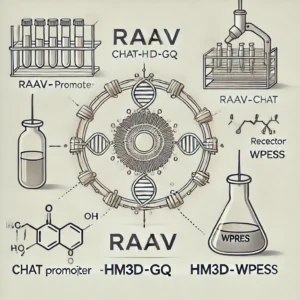
rAAV Production and Design
Recombinant AAV vectors are widely employed due to their safety profile and ability to target non-dividing cells. The rAAV-ChAT-hM3D(Gq)-WPREs vector integrates several genetic components for optimized research use:
- ChAT promoter for specificity (Learn more).
- hM3D(Gq) receptor for chemogenetic applications (Read about chemogenetics).
- WPREs for expression efficiency (NIH resource).
Applications in Research
- Neurological Disorder Modeling
This vector aids in modeling diseases such as Alzheimer’s and Parkinson’s, offering insights into cholinergic dysfunction.
Understand neurodegeneration mechanisms at NIA. - Behavioral Neuroscience
Researchers can modulate specific neuronal circuits to study behavior and its underlying neural mechanisms.
Explore behavioral neuroscience at NSF.gov. - Optogenetics and Circuit Mapping
The precise control of cholinergic neurons using chemogenetics enhances circuit mapping techniques.
Optogenetics overview at NIH.
Ethical and Safety Considerations
Gene therapy tools like rAAV-ChAT-hM3D(Gq)-WPREs require rigorous ethical scrutiny, particularly in animal studies and potential clinical applications.
Read about ethical considerations in gene therapy at FDA.gov.
Animal welfare guidelines at USDA.gov.
Further Reading and Resources
- Cholinergic systems and their role in cognition.
- Chemogenetics: A revolutionary tool for neuroscience.
- rAAV safety and applications in gene therapy.
- Enhancements in vector technology at NCBI.
- WPRE mechanisms in post-transcriptional regulation.
- Gene delivery systems for neuroscience.
- NSF-funded research on neural circuits.
- Behavioral models in neuroscience research.
Conclusion
The rAAV-ChAT-hM3D(Gq)-WPREs vector represents a powerful tool in modern neuroscience, enabling targeted studies of cholinergic systems and advancing our understanding of brain function and disease. Its integration of chemogenetics and enhanced expression systems makes it a valuable asset for researchers aiming to unravel the complexities of neural circuits.
For further insights into its applications and protocols, explore resources from NIH, NSF, and FDA