The Mouse Anti-Chick Type II Collagen IgG1 Antibody ELISA Kit is a specialized immunoassay designed for the detection and quantification of mouse anti-chick type II collagen IgG1 antibodies. This kit is particularly valuable in research related to autoimmune diseases such as rheumatoid arthritis and cartilage-related studies.
Key Features of the ELISA Kit:
- Specificity: The kit specifically detects IgG1 antibodies against chick type II collagen.
- Sensitivity: It provides high sensitivity for accurate quantification in serum or other biological samples.
- Reproducibility: Ensures consistent results across multiple experiments.
- Convenience: Simple, step-by-step protocols for ease of use.
For detailed technical information on ELISA methodologies, you can refer to NIH resources and educational materials from PubMed Central.
Applications of the Kit
- Autoimmune Disease Research:
- The kit is widely used in models of collagen-induced arthritis (CIA) to study immune responses to type II collagen.
- For an in-depth understanding of collagen-induced arthritis, explore studies at the Arthritis Foundation.
- Cartilage Biology:
- Chick type II collagen is a crucial component of cartilage, making this kit ideal for cartilage repair and regeneration studies.
- Visit the Orthopaedic Research Society for resources on cartilage research.
- Drug Development:
- The ELISA kit assists in the evaluation of therapeutic interventions targeting autoimmune conditions.
- Learn more about preclinical studies involving ELISA kits from the FDA.
OPD as a Substrate in ELISA
The OPD (o-phenylenediamine dihydrochloride) substrate is commonly used in ELISA for colorimetric detection. In this kit, OPD reacts with the enzyme-linked secondary antibody to produce a yellow-orange product, which can be measured at 450 nm using a microplate reader.
Advantages of OPD:
- High sensitivity for low-abundance targets.
- Stable and reproducible colorimetric signal.
- Easy handling and compatibility with standard ELISA protocols.
For a guide on ELISA substrate selection, visit Thermo Fisher Scientific.
Step-by-Step Procedure for the ELISA Kit
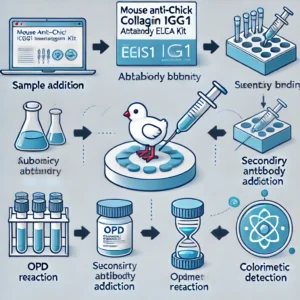
- Coating: The microplate is pre-coated with chick type II collagen.
- Sample Addition: Mouse serum or test samples are added to the wells, allowing antibodies to bind to the antigen.
- Secondary Antibody: A conjugated secondary antibody is added to detect the bound IgG1.
- Substrate Reaction: OPD substrate is added to produce a measurable colorimetric change.
- Detection: Results are read using a microplate reader at 450 nm.
For more about ELISA techniques, explore Educational Resources from the CDC.
Storage and Stability
The kit components should be stored at 2–8°C and are stable until the expiration date printed on the label. Avoid repeated freeze-thaw cycles to maintain reagent integrity. For storage and handling guidelines, consult the World Health Organization (WHO).
Advantages of Using the Kit
- Efficiency: Minimal hands-on time with quick turnaround for results.
- Accuracy: High specificity for IgG1 subclass ensures reliable data.
- Versatility: Suitable for various research applications, including arthritis and cartilage biology.
Frequently Asked Questions (FAQs)
- Can the kit be used for other species?
- No, this kit is designed specifically for detecting mouse antibodies against chick type II collagen.
- What is the dynamic range of detection?
- The kit typically provides a dynamic range of 1–100 ng/mL, but this may vary depending on experimental conditions.
- Is OPD the only substrate option?
- While OPD is the preferred substrate for its sensitivity, other substrates like TMB (3,3′,5,5′-Tetramethylbenzidine) can also be used depending on assay requirements.
For more troubleshooting and FAQs, visit ELISA Technical Support at NIH.
Conclusion
The Mouse Anti-Chick Type II Collagen IgG1 Antibody ELISA Kit is an invaluable tool for researchers studying autoimmune diseases, cartilage biology, and antibody responses. Its integration of OPD as a substrate ensures precise and reliable results. For more information on purchasing or using this kit, consult trusted suppliers and scientific resources, such as Thermo Fisher and NIH.