Plasma membrane isolation is a critical process in cell biology, allowing researchers to separate plasma membranes from other cellular components for the analysis of proteins, lipids, and signaling pathways. The Plasma Membrane Isolation Kit is an indispensable resource for scientists, offering a streamlined and reliable method to purify plasma membranes from a variety of cell types. This article explores the key features, workflow, and applications of this kit, with comprehensive references to government and educational resources for further exploration.
What is Plasma Membrane Isolation?
The plasma membrane is a dynamic structure that regulates the movement of molecules in and out of cells, plays a key role in signal transduction, and provides structural integrity. Isolating this membrane is essential for studying membrane-associated proteins, lipid composition, and receptor-ligand interactions. Explore a detailed overview of the plasma membrane at the National Human Genome Research Institute (NHGRI) and the National Center for Biotechnology Information (NCBI).
Key Features of the Plasma Membrane Isolation Kit
- High Purity and Yield
This kit ensures high-purity plasma membranes with minimal contamination from other organelles. Review membrane isolation techniques at NIH’s National Institute of General Medical Sciences (NIGMS). - Rapid and Reliable
The protocol is optimized for speed and reproducibility, making it suitable for high-throughput applications. Learn more about rapid isolation methods at Cold Spring Harbor Laboratory Protocols. - Wide Compatibility
The kit is compatible with mammalian, insect, and some plant cells. Explore comparative studies at DOE Office of Science.
Workflow for Plasma Membrane Isolation
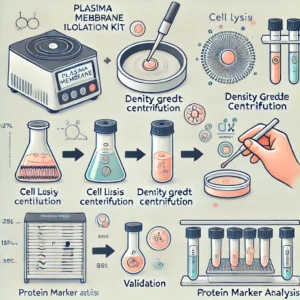
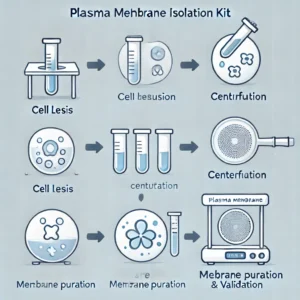
1. Sample Preparation
Cells are collected and lysed using the reagents provided. This step is critical to maintaining the integrity of the plasma membrane. For tips on cell lysis, visit Addgene’s Resource Hub.
2. Density Gradient Centrifugation
The lysate is subjected to a density gradient centrifugation step, separating the plasma membrane from other organelles like mitochondria and the nucleus. For centrifugation protocols, refer to NCBI’s Methodology Section.
3. Purification
Plasma membranes are collected and washed to ensure high purity. See detailed protocols at NIH Cell Biology Resources.
4. Validation
The purity of the isolated membrane is validated using protein markers, such as Na+/K+ ATPase, via Western blotting or immunostaining. Learn more about marker validation at Genome.gov.

Applications of the Plasma Membrane Isolation Kit
1. Membrane Protein Analysis
Membrane proteins are critical targets for drug development, making their isolation essential. Explore drug discovery applications at FDA Science & Research.
2. Lipidomics
Isolated plasma membranes are ideal for studying lipid composition and metabolism. Learn more about lipidomics techniques at NIH Lipidomics Research Program.
3. Signal Transduction Studies
Plasma membranes play a pivotal role in cell signaling. Researchers can study receptor-ligand interactions and downstream pathways. For signaling pathway databases, visit KEGG Pathway Database.
4. Drug Delivery Research
Understanding the properties of plasma membranes aids in designing efficient drug delivery systems. Explore nanotechnology and membrane research at NIH Nanotechnology Initiatives.
Advantages of the Plasma Membrane Isolation Kit
- Simplified Protocol
The kit reduces the complexity of traditional plasma membrane isolation methods. For historical methods, visit NCBI’s Historical Research Articles. - Enhanced Reproducibility
Optimized reagents ensure consistent results across experiments. For reproducibility guidelines, refer to NSF’s Research Guidelines. - Scalability
Suitable for both small-scale academic research and large-scale industrial applications. Learn more about scaling experiments at DOE Science Programs.
Recent Innovations in Plasma Membrane Isolation
1. Microfluidics-Based Isolation
Emerging microfluidics technologies enable highly efficient membrane isolation. Explore microfluidics innovations at NIH Microfluidics Program.
2. Proteomics Integration
Advances in mass spectrometry allow for comprehensive proteomic analysis of isolated membranes. For proteomics research, visit NIH Proteomics Research Resources.
3. High-Throughput Screening
Automation and robotics are increasingly used to scale up membrane isolation processes. Learn more at DOE High-Throughput Biology Program.
Future Directions
Plasma membrane isolation kits are continually evolving with advancements in nanotechnology, proteomics, and automated workflows. These innovations promise to enhance our understanding of membrane dynamics and their roles in health and disease. For the latest research, visit trusted resources like NCBI, NIH, and CDC.